
Find the Rich County Owner of Record
The practical route starts with an address and ends at a recorded instrument. Rich County's advanced tax form takes several inputs. Enter a house number and street. An owner name also works. A parcel number, a tax year, or legal text works too. Any of these can pin down the parcel you need. Treat the first name match as a lead only. The parcel key and legal description matter here. They tell you whether it is truly the property you mean.
Then confirm the current vesting deed with the Recorder & Surveyor. A vesting deed names the grantee in the transfer. If a trust or company holds the parcel, the deed's exact legal name matters. Match the spelling character for character. This method answers the basic question of who owns the property. The full chain of title belongs to the deed and former-owner records. The copy procedure belongs there as well.
- Search the address, owner name, or parcel in Rich County’s tax search.
- Copy the current parcel key and legal description from the matching record.
- Ask the Recorder & Surveyor to locate the latest vesting deed and compare its parties and description.
- If an entity or estate is named, keep that exact legal name and confirm related filings through the appropriate official record source.
Rich County Sources That Name an Owner
More than one county system can name an owner. The assessor's tax roll ties a parcel to an owner field and mailing details. The recorder's filed instruments name the parties to each transfer. The GIS viewer helps locate a parcel. The county's tax-sale list also prints an owner and mailing address beside each parcel and its redemption fields. Read every source for its purpose and its date.
| Source | Owner Info It Gives | Access |
|---|---|---|
| Assessor tax roll | Tax parcel and owner-of-record field; sample card fields not captured | Advanced county search with CAPTCHA |
| Recorder instrument | Named grantor and grantee in a recorded deed | Ask the Recorder & Surveyor; public index coverage is unverified |
| Tax-sale PDF | Owner, mailing address, parcel, amount, redemption details, legal description | Posted county list; a row is not proof of completed sale |
| GIS parcel viewer | Map location; live popup fields not confirmed | County ArcGIS link; compare with assessor and plat |
The owner of record is the party named in the county record. That label names no occupant. It also skips contact preferences and the beneficial interests inside a trust or company. Rich County tax-sale entries show mailing addresses that can be PO boxes or out of state. The legal description still points to local land. For current details, the current owner record page explains how to compare roll and deed evidence. Weigh both sources.
Use the Rich County Owner Field as a Lead
The Advanced Property Tax Search includes an Owner Name field. That field accepts wildcards. The form adds a wildcard at the end by default. Place a percent sign before your text to search within a name. A query can surface records under a surname, a trust, an estate, or a business. Use it to find a parcel. Do not treat it as a complete list of interests. It is not a verified person-to-property link either.
A familiar name is only the start. Compare the parcel number, the legal description, and the situs address. A deed then verifies the party and the date of transfer. Search the exact legal entity spelling first. Do not assume a similar individual is the owner. Entity lookups should begin through the official state business-search service. Confirm its current endpoint before relying on it.
Separate Owner, Situs, and Mailing Details
A situs address describes where the land sits. A mailing address tells a tax notice where to go. The two can differ. The county tax-sale PDF shows an owner name and mailing address. They sit printed beside a legal description for a Rich County subdivision. A PO box or an out-of-state address can appear. A different street can appear too. None of that proves a move or a mistake.
Use the parcel key to connect the two. Rich County's assessor search offers house-number and street fields. There is no ZIP field on the form. County addressing rules let the recorder or a designee administer street addresses. The rules also cover adding private lanes and addressing split parcels. A new road name can differ from an older deed. When the strings clash, keep both. Ask the county to match them by parcel and legal text.
Confirm a Rich County Name in the Deed
The recorder confirmation is the check that matters after an assessor search. Rich County's Recorder & Surveyor maintains ownership instruments, liens, legal descriptions, and plats. Its public page publishes no online grantor-grantee index. So ask the recorder directly. Request the latest vesting deed using the current parcel, owner name, legal description, and an approximate date. Note the instrument reference. Compare the grantee with the tax roll.
A deed can name a trust, an estate, a spouse, an entity, or a representative capacity. Never shorten the legal name when comparing records. The recorded document is proof of what was filed. A full title review goes further. It checks later transfers, releases, liens, and related instruments. The Rich County deed records page covers the recorder route and copy limits in detail.
Rich County Property Watch Needs Verification
Rich County's home page promotes a "Property Watch" signup pointing to search.richcounty.gov. The link leads to a county-related destination. What the signup collects is not stated anywhere on the surface. What it costs is not stated either. Whether it tracks a parcel or a person is not stated anywhere on the surface. Treat it as a reason to verify. It is not proof of fraud monitoring. No alert guarantees that every recording will come to light.
For a deed concern, contact the Recorder & Surveyor directly. Ask what monitoring or correction options the office recognizes. Keep the parcel number and its recording reference close at hand when you call. Never send identity documents or payment through a page you cannot verify. A public owner lookup is one tool. A county notification service is another. Each has separate limits.
Trust, Estate, and Company Names in Records
Land does not always sit in a person's name. A trust, company, estate, or personal representative may hold title instead. Rich County probate materials note that an executor deed, administrator deed, or beneficiary deed can tie an estate case to a land record. The assessor's owner field may also differ from whoever paid a tax bill or gave an address. So compare names with care. Match the legal name on the vesting instrument against the parcel description before concluding anything.
When an owner dies, look to the probate file. It may hold an appointment, inventory, will, final accounting, or transfer order. A death certificate alone does not establish current title. Search two sources separately. Query the county recorder, then Utah Courts XChange. Ask the court clerk about anything that is not online.
Limits of a Rich County Owner Lookup
A public owner lookup shows recorded information. It does not prove who lives at the address. Nor does it settle private arrangements or clear title. A mailing address is not an invitation to contact or approach the person there. Utah Safe at Home provides eligible participants with a legal substitute address and protects specified location information. Public-record research must not defeat those safeguards. The official Utah Safe at Home program page lays out the substitute-address system, which concerns privacy rather than any property-owner result.
Use what you find for lawful property research, due diligence, and civic purposes. Respect any protected address or record.
Lawful use. Rich County owner information is for legitimate property research and due diligence. It must not be used to stalk, harass, intimidate, or harm anyone.
Keep Voter Status Separate From Property Ownership
Utah's voter-registration portal offers an official status lookup. That tool belongs to election services. It is not a property-owner index. The portal also describes public status details and privacy options for people at risk. A voter result proves no ownership, occupancy, or parcel connection. For those questions, use the deed and the tax record. The linked Utah voter-registration status portal is a separate government lookup, and a status result stays within the election system rather than the Rich County land record.

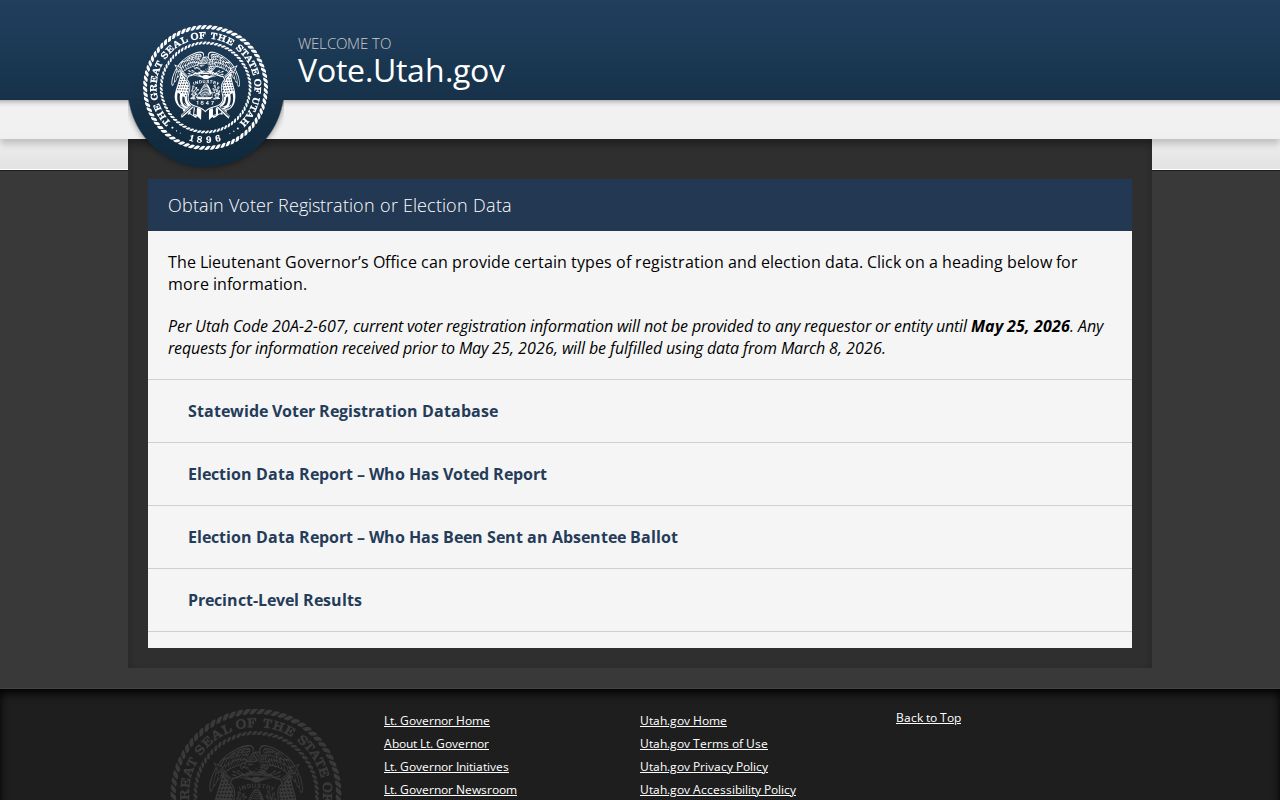
A voter-status page proves no property rights. Never use it to find a protected home. Utah also maintains a separate voter-registration and election-data request page. That page describes a tab-delimited format. It lists a $1,050 fee, and it asks requesters to confirm current terms. Those data are not a deed, an assessor record, or ownership verification.
The distinction matters. Use county land records for parcel ownership, and never turn unrelated public information into a way to contact or locate an individual.