
What a Rich County Property Value Means
Not every dollar figure means the same thing. The Rich County Assessor sets the assessed value and classification for locally assessed property. The Clerk/Auditor handles the annual valuation notices and the tax-rate material that follows. A recorded deed proves a transfer happened. Its specific fields, though, and the sale-price fields on a standard assessor card, can only be confirmed on the source record itself. The table draws that line clearly.
| Value | What It Is | Where |
|---|---|---|
| Assessed value | Value assigned in the county tax record | Rich County Assessor; confirm the year and live fields. |
| Market value | A sale-based estimate, not verified as a displayed assessor field | Use a qualified appraisal or verified market evidence. |
| Last sale consideration | Transfer amount if stated in the relevant instrument | Recorder deed; sample result fields were not captured. |
| Land and improvement split | Exact parcel-card fields were not verified | Check the current assessor record directly. |
Rich County publishes no fixed assessment ratio, valuation method, or revaluation year on this point. So treat any single parcel's ratio as coincidence. An assessed figure is not what a buyer would pay. For every number, record the publishing office, the year covered, and the label on it. The label may be an assessed figure, a recorded consideration, or a separate appraisal. That label matters most.
Find a Rich County Assessed Value
The county's Advanced Property Tax Search accepts a parcel number, tax year, owner name, house number, street, or legal description text, and at least one field is required. The form includes a human-verification step. Use the current parcel key whenever you can. If your only identifier comes from an older deed or tax notice, compare the old and new number patterns before concluding the parcel has no value record.
- Search the assessor form by parcel, address, owner, tax year, or legal phrase.
- Confirm the parcel and legal description belong to the property in question.
- Read the value and tax year actually shown on the live record.
- Use a recorded deed or qualified appraisal for a separate sale or market measure.
- Assessed value
- The value entered for county property-tax administration.
- Market value
- A value estimate tied to market evidence; it is not the tax figure by default.
- Sale consideration
- The transfer amount stated in a deed or related record, when present.
- Assessment ratio
- A comparison between assessed and market values; Rich County’s current ratio was not verified.
What a Rich County Assessment Does Not Say
An assessed figure is a tax record, nothing more. It does not guarantee a sale price. It does not replace a licensed appraisal or describe a building's condition. It can also differ from a later transfer amount because the dates and purposes differ. Rich County publishes no county-specific market-to-assessment ratio, revaluation year, or update lag. So avoid using one assessed value as a price forecast.
Value versus price. A Rich County assessor value is used for tax administration and is not an appraisal or promised sale price. Use an appropriately qualified appraiser for a transaction valuation.
Where Rich County Values Are Recorded
The Assessor maintains the assessed-value and classification record. The Clerk/Auditor prepares annual valuation notices and administers Board of Equalization matters. The Treasurer handles the bill, payment, and tax-sale side. A deed records an ownership transfer. Its image may state consideration, though the deed-index result and exact consideration field vary by record. The Rich County Clerk/Auditor page links valuation notices and appeal material. That office route is what the official page displays, not a parcel-specific value record.
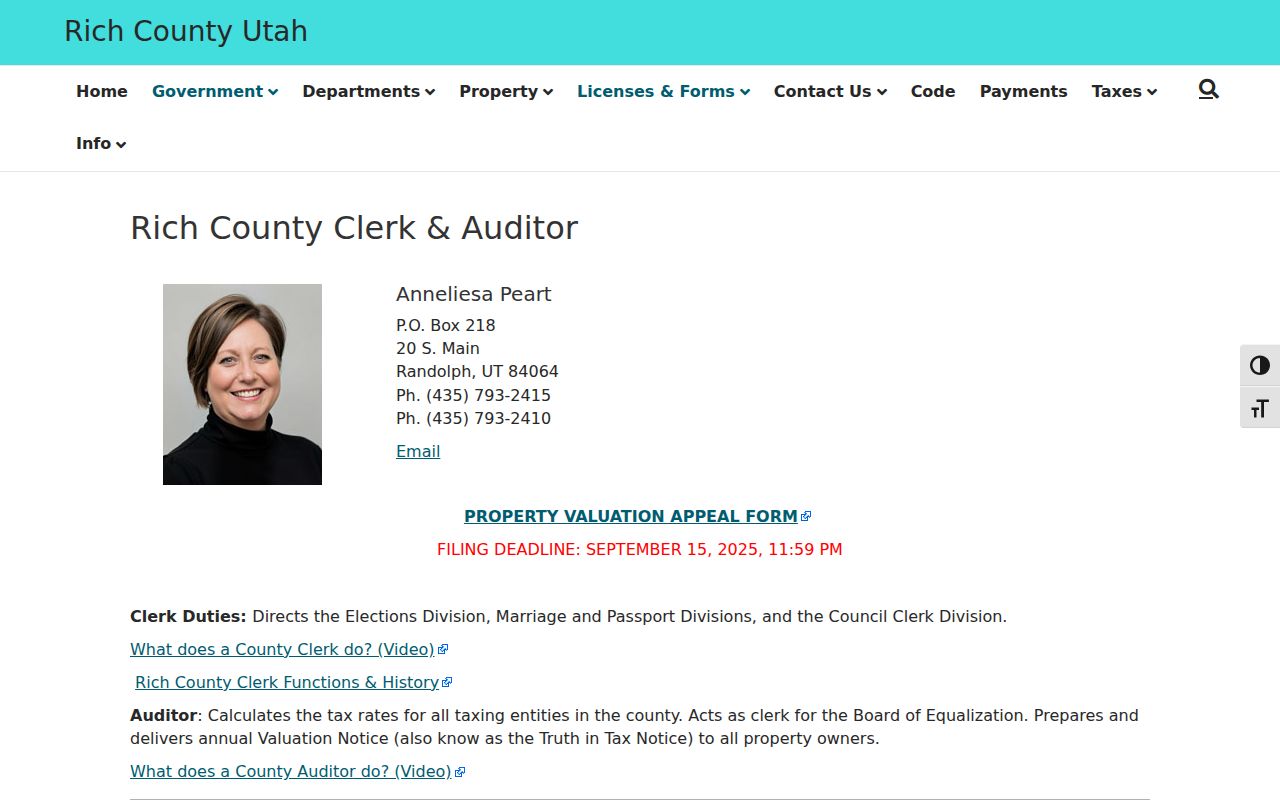
Use the notice to identify the year and the appeal route. Then read the value from the matching assessor record.
Keep the Rich County Parcel and Year Together
A value without a parcel key and tax year is hard to compare. Rich County's search form includes a Tax Year field. But it does not state its full available-year range. The Treasurer also documents a parcel-number change: 12-34-56-789 became 12-34-560-0789 after two zeros were added. Use the correct version. Keep the tax year when comparing notices or a historical record.
The format change does not mean the land or its value changed. Confirm the legal description and parcel before comparing one year with another. A past bill may use a different key. Ask the Assessor or Treasurer how the current account matches it.
Classification Can Affect Rich County Tax Figures
The Assessor's page links a greenbelt application, and the Treasurer administers statutory tax relief. Classification and relief routes can change a tax record. They do so without touching the underlying deed or legal description. The current application conditions, required materials, and parcel-card classification fields live on the official form and live record. Check those before making a comparison. An earlier owner's tax record may differ from a current one. Do not assume the value itself changed for one reason. The year, classification, parcel split, or account name may have shifted instead. Confirm with the Assessor rather than inferring a cause from the dollar amount alone.
Compare Rich County Property Context Carefully
Rich County's plat directory shows a varied Bear Lake landscape. Resort phases, condos, golf-course subdivisions, townhomes, and camper or RV parks sit alongside rural and town parcels. That inventory helps you choose comparable property groups. But the list is not a value trend. Garden City, Randolph, and Laketown publish no official value series. No current county revaluation effect is on file. Compare the same tax year, property type, location, and record purpose. Use a plat name and phase to confirm two parcels sit in similar settings. Subdivision counts and folder names say nothing about appreciation. For billing, exemptions, and appeals, use the separate Rich County property tax records path.
Use the Rich County Valuation Notice for an Appeal
The Clerk/Auditor mails annual valuation notices and doubles as clerk for the Board of Equalization. That notice anchors any tax appeal. It ties one assessed figure to one parcel and one tax year. Before gathering evidence, lay the notice beside the Assessor's live record. Check the parcel number, the legal description, and the owner of record. A mismatch may appear in the parcel key. It may also appear in the subdivision phase or a name. Fix any mismatch first. Otherwise the appeal lands on the wrong account.
The deadline for filing appears on the notice itself. So do the submission method and the evidence the county requires. Deadlines shift from year to year. Follow the instructions issued for the current tax year rather than a prior cycle. Then confirm the appeal calendar with the Clerk/Auditor's office before the date arrives.
Keep a copy of the notice, the year's assessment entry, and anything the instructions request. The Treasurer's tax bill answers what is due; it is not an appeal decision. Value questions go to the Assessor and Clerk/Auditor. Payment questions go to the Treasurer.
Separate Assessment, Classification, and Tax Bill
The Clerk/Auditor prepares Rich County's annual valuation notices. It also serves as clerk for the Board of Equalization. That notice anchors any tax appeal. It ties an assessed figure to one parcel and one tax year. Before gathering evidence, compare its parcel number and legal description against the Assessor's live record. Clear up any mismatch in parcel key, subdivision phase, or owner of record first. An appeal should concern the right account from the start.
Appeal deadlines are set each year. The notice itself governs the applicable year. The current Clerk/Auditor instructions cover submission method and evidence requirements. Never rely on a prior year's timeline, because appeal calendars and form fields change. Check the notice issued for the property before assuming any cutoff.
Keep a copy of the notice. Keep the year-specific assessment entry too. Save whatever the current appeal instructions request. The Treasurer's tax bill answers what is due. It is not an appeal determination. A value question belongs with the Assessor and Clerk/Auditor. Payment status belongs with the Treasurer. Label each document and date when building the property history.